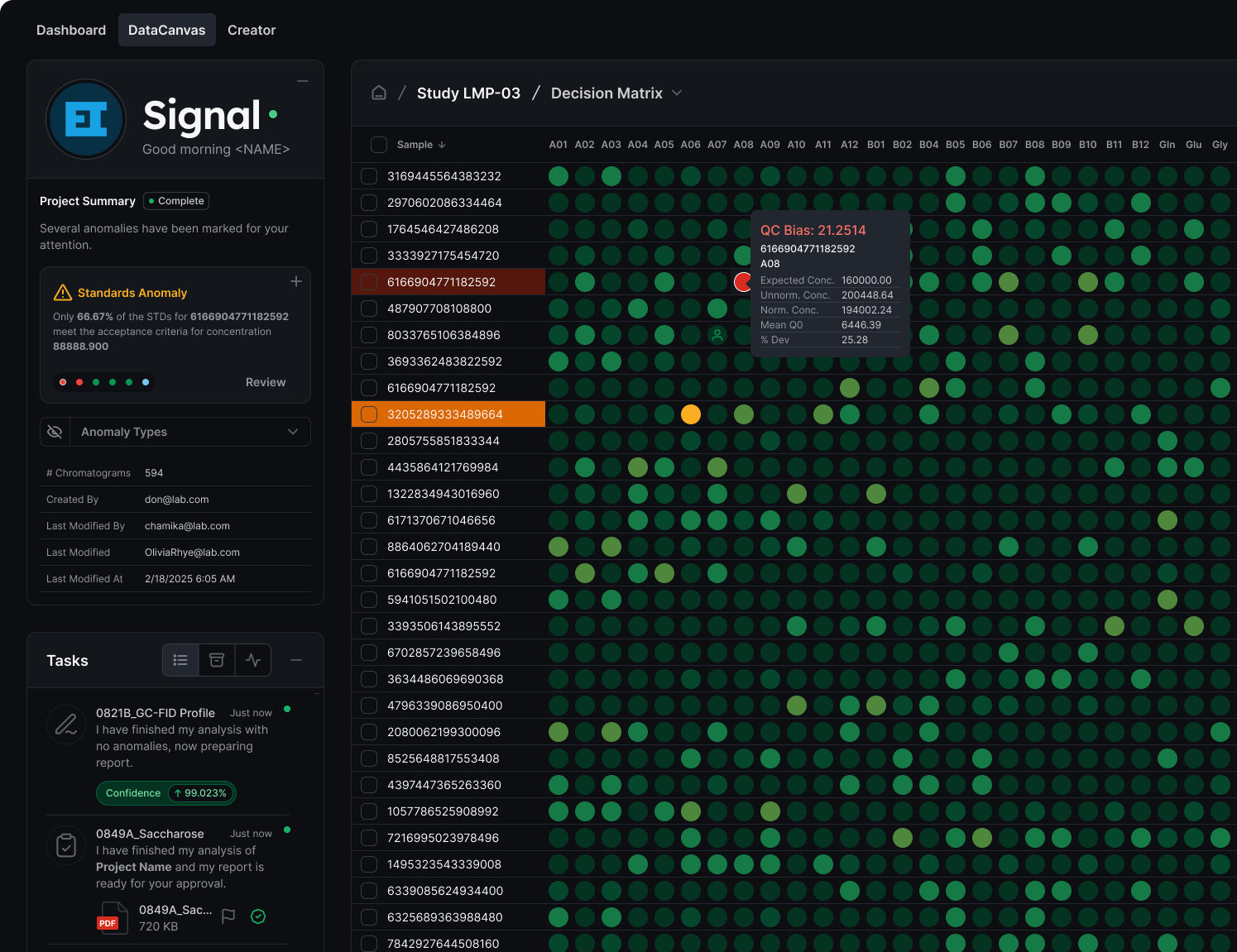
Automate the wet lab.
Scale scientific judgment.
Analytical review takes hours or days, a bottleneck in an increasingly automated lab. EI’s foundational model applies your scientists’ judgment as a governed standard wherever the method runs, compressing development time and increasing confidence in every decision.
A unique AI architecture designed to be developed by your scientists.
EI’s Limited Sample Model (LSM) is the foundational technology driving the whole platform. Shaped by the constraints of the lab and the requirements of the scientists, it delivers accuracy, consistency, and governance in regulated environments.





The bottleneck, cleared end to end.

One platform.
Every result connected.
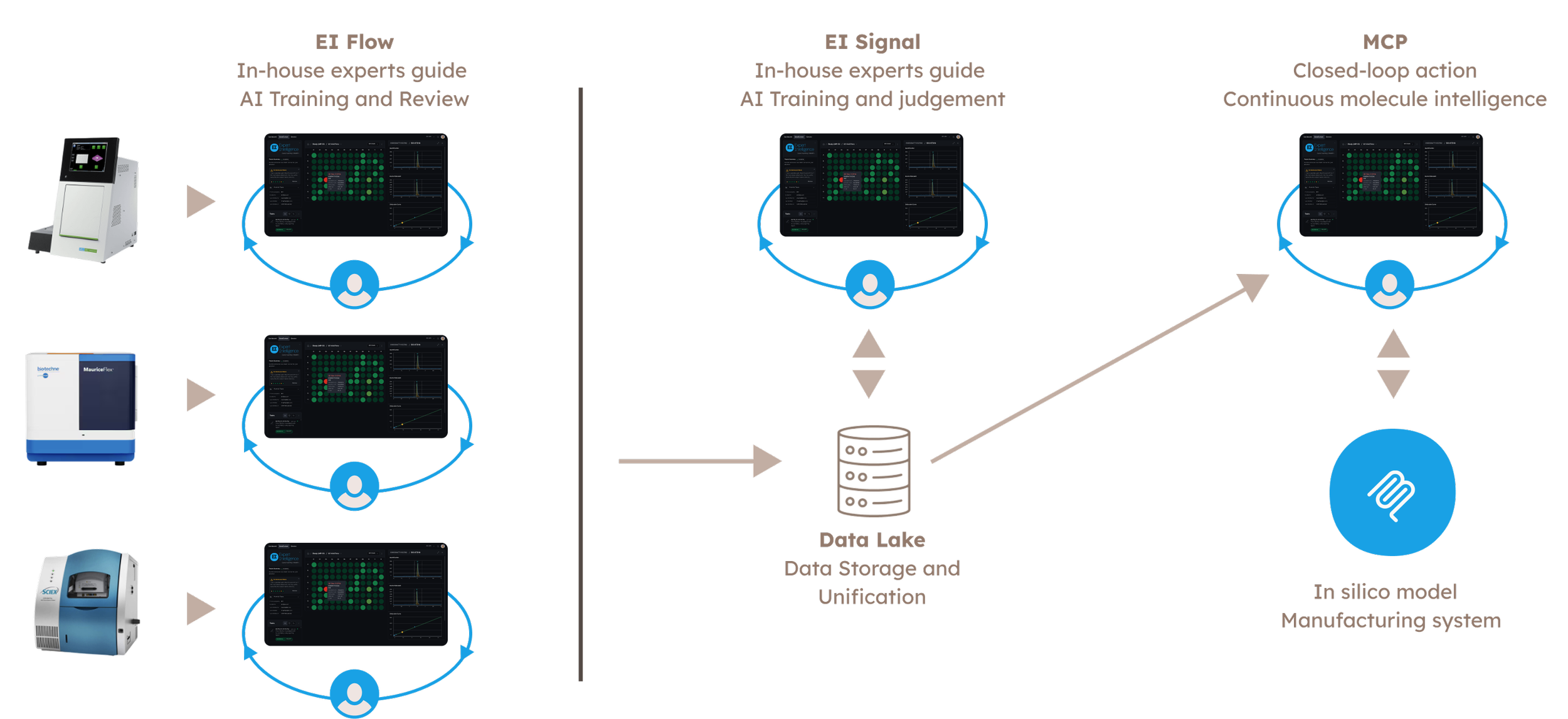
Three layers turn validated evidence from across your labs into a continuous understanding of each program, so every new result informs what comes next from design through manufacturing.
Judgment.
EI Flow deploys that governed judgment wherever the method runs, across internal labs and partner sites. Routine review is automated in parallel, while the scientists who created the model can review exceptions remotely and direct further refinement from one place.
Oversight.
EI Signal builds on the continuous stream of governed decisions created by EI Flow, weaving them across instruments, workflows, studies, and labs over time. Patterns, drift, and dependencies become visible at every level, turning scientific judgment into intelligence across the organization.
Action.
Model Context Protocol (MCP) allows authorized people, models, and systems to put that intelligence to work, from improving in silico design upstream to guiding manufacturing and quality downstream. When those actions produce new laboratory results, EI reads that governed evidence, closing the loop while preserving the integrity of the scientific record.
“Every long-term study is now watched as it runs. We catch a trend forming and act months before it could become a warning letter...”
— Head of Quality, Global Pharmaceutical Company

Deploy where your data needs to live.
EI is vendor-agnostic and connects with the instruments, LIMS, and approved enterprise systems you already use without replacing your existing lab infrastructure. Deploy the platform according to your security, data-residency, and latency requirements. Your data remains within the environment you authorize and is never mixed across customers.
Cloud
A managed cloud deployment speeds implementation and scales access across laboratories and sites while maintaining governed security and availability.
Private Cloud
Run EI in dedicated cloud infrastructure aligned with your organization’s security, networking, and data-residency policies.
Hybrid
Place data and processing where each workflow requires while connecting instruments, laboratories, and enterprise systems across environments.
On-premises
Keep processing and data inside your controlled network when local latency, residency, or security requirements demand it.

Built for compliance and validation.
EI is designed for regulated laboratories where every electronic record, model change, and decision must remain secure, traceable, and defensible.
21 CFR Part 11
EI supports compliant electronic records and signatures with complete audit trails, controlled versions, traceability, and secure retention and archival. Every result remains connected to its source data, review history, and model version.
GxP readiness
EI supports GLP- and GMP-aligned workflows through risk-based computer system validation and GAMP 5 practices. IQ, OQ, and PQ documentation supports qualification, deployment, and controlled change.
SOC 2 Type II
Security, availability, and confidentiality controls are independently examined over time. Continuous monitoring, incident response, backup, and recovery protect the systems and data your laboratories depend on.
Data privacy and residency
Configurable residency and sovereignty controls keep data within approved environments. Encryption at rest and in transit and GDPR-aligned handling protect data across cloud, on-premises, and hybrid deployments.

Case Study
Case Study
Case Study
Frequently asked questions.
-
LSM is designed for defined analytical decisions, not broad, open-ended generalization. It learns the structure of your instrument data and the confidence boundaries around your scientists’ decisions. Your scientists benchmark it against their reviewed work, resolve inconsistencies, and approve each model version before production. Data outside its validated boundaries goes to an expert rather than being forced into an answer.
-
Implementation starts with one workflow and the reviewed examples, SOPs, acceptance criteria, and systems that support it. The model is trained and benchmarked against your experts, then integrated into your environment. Validation, security review, and change control are completed before production.
-
EI is vendor-agnostic and connects to the data sources and systems your lab already uses, from controlled file exchange to direct integration with instruments, vendor software, LIMS, and enterprise systems. It can run in an approved cloud, private cloud, on-premises, or hybrid environment. Data residency, access, and processing are configured around your requirements, and customer data and models are never mixed across organizations.
-
EI provides the technical controls and documentation needed to support regulated and accredited laboratories, including audit trails, electronic records and signatures, access controls, model versioning, validation documentation, and controlled change. Compliance and accreditation apply to the laboratory’s validated use, procedures, and quality system, not to software alone.
-
LSM is EI’s foundational model, built for laboratory instrument data and defined analytical decisions. It is deterministic, learns from your scientists’ reviewed work, and routes anything outside its confidence boundaries to an expert. Large language models generate language probabilistically and do not make EI’s analytical decisions. Raw data remains unchanged, and generative tools used to explain information do not create or alter the analytical result.
-
Routine review moves from manual queues to governed automation and review by exception. Scientists become the creators and governors of the models that scale their judgment, while leadership gains a consistent standard across workflows, labs, and external partners.
-
EI Flow models can be deployed and validated wherever the method runs, allowing the same scientific standard to operate across internal labs, sponsors, CROs, and CDMOs. Scientists can review exceptions and refine models remotely, while access, data residency, model versions, and audit trails remain governed. This supports consistent review and method transfer in either direction.
-
We establish a baseline for manual review, rework, failed runs, delayed decisions, and expertise that cannot scale. The initial deployment measures changes in cycle time, throughput, consistency, and avoided work. Those results provide the business case for bringing EI to additional methods and labs.
-
Pricing reflects the workflows being automated, their complexity and processing volume, integration and deployment requirements, and the scale of the rollout. The commercial approach is built around a defined starting scope and the value expected from it, then adapted as deployment expands.
-
EI Flow creates governed decisions at the point of analysis, and EI Signal connects them across the organization. MCP makes that intelligence available to authorized people, models, and systems, from in silico design to manufacturing and quality. When those actions produce new laboratory results, EI reads that governed evidence through the same controlled path, extending understanding while preserving the scientific record.
See it in action.
Request a demo and see how trusted results compress the time and cost of drug development.